
Crete is not only the largest island in Greece and the most popular destination for foreign property buyers, but also one of the most complex markets from a legal perspective. Spanning four distinct provinces, the island has a mix of military border zones, properties with unclear ownership chains inherited from previous generations, building violations resulting from decades of unregulated construction, and agricultural land with strict transfer restrictions. This guide covers the legal realities of buying property in Crete, explaining what issues tend to arise, where they appear, and how to identify them before they become problems.
Where people buy in Crete and what it means legally
Crete’s four provinces are not interchangeable. Each one presents a different legal profile for international buyers, and understanding the distinction matters before you begin searching.
Chania
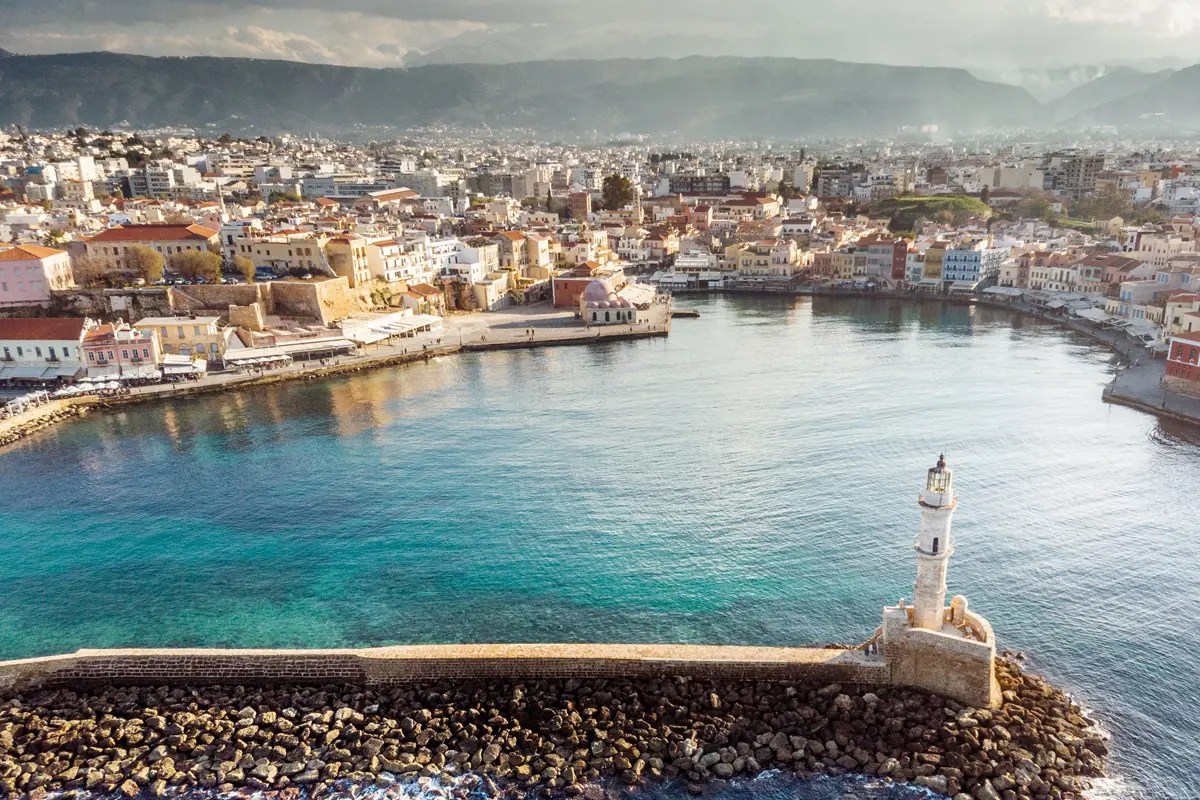
Chania is the most popular province among northern European and British buyers. The old town, the coastal strip from Platanias to Kissamos, and the hillside villages behind it attract the majority of international interest. Chania also happens to contain some of Crete’s designated military border zones, which restrict purchases by non-EU citizens. In certain municipalities within these zones, buyers who are not EU nationals must apply for a ministerial authorisation before any transaction can proceed. This is not a formality — the application goes through the Ministry of Defence and can take several weeks. If you are a British (post-Brexit), American, Australian, or Canadian buyer looking at property in western Crete, this is one of the first things your lawyer should verify.
Heraklion
Heraklion is the most urbanised and commercially active property market on the island. There are more transactions, more supply, and more variety than in any other Cretan province. Military border zone restrictions are less prevalent here. The more common issue in Heraklion is building irregularities: older apartments and houses, particularly those built between the 1970s and 1990s, frequently have unauthorised extensions, enclosed balconies, or converted basements that were never formally permitted. These irregularities affect the property’s legal transferability and need to be identified and assessed during due diligence.
Rethymno
Rethymno sits between Chania and Heraklion, both geographically and in terms of market character. The province is known for stone-built village houses, partially renovated rural properties, and hillside villas. The legal issue that surfaces most often here involves renovation permits. Many of the restored or semi-restored stone houses that attract buyers were renovated without proper building permits, or with permits that covered only part of the work actually carried out. A property can look finished and move-in ready while having significant unresolved permit issues that complicate or block the transfer.
Lasithi (including Elounda)
Lasithi is Crete’s eastern province and home to the island’s luxury segment, particularly around Elounda and Agios Nikolaos. Properties here tend to be higher-value — villas with sea views, private pools, and large land plots. The legal issue specific to this market is valuation divergence: the gap between a property’s declared value for tax purposes (the objective tax value set by the Greek state) and its actual market price can be substantial. This has direct fiscal implications for both transfer tax and capital gains, and the structure of the transaction needs to account for it. If you are considering a high-value purchase in eastern Crete, the tax planning needs to happen before the preliminary agreement, not after.
Legal issues that come up specifically when buying in Crete
Every property market in Greece has its own set of risks. Those in Crete are shaped by the island’s size, military significance, construction history and the nature of land ownership. The issues below are not theoretical; they arise regularly in real transactions.
Military border zones
Parts of Crete are classified as border zones under Greek defence regulations, particularly along the western and southern coasts. In these areas, non-EU citizens require an authorisation from the Ministry of Defence before they can acquire property. The restriction applies to the purchase itself, not just to the use of the property. The practical consequence is that a buyer from the UK, the US, Canada, or Australia may find a property, agree terms with the seller, and only then discover that a multi-week government approval process stands between them and the notarial deed. In some cases, the authorisation is granted routinely; in others, it is refused. Your lawyer should check the property’s classification before you enter into any binding agreement.
Building violations and regularisation
Unauthorised construction is widespread in Crete, particularly in properties built between the 1970s and early 2000s. Common violations include building extensions beyond the permitted footprint, constructing additional floors or rooms without permits, counting enclosed terraces or balconies as interior space, and using agricultural outbuildings without formal registration. Under Greek law, a property with unresolved building violations cannot be legally transferred. However, Greece operates a rolling regularisation framework (most recently under Law 4495/2017 and subsequent amendments) that enables property owners to legalise certain violations by paying a fine and registering the irregularity. For any buyer, the key questions to avoid these common risks are whether the violations on a specific property are eligible for regularisation, how much it will cost, and whether the seller has already completed the process.
Agricultural land
Much of Crete’s extensive agricultural land is planted with olive groves and vineyards, while some areas remain as open rural terrain. Prospective buyers need to understand the distinction between agricultural land, forestry land, and buildable rural land. Agricultural land is subject to strict building limitations, including minimum plot sizes and maximum building coverage ratios. In some cases, residential construction is prohibited outright. Forestry land is subject to even tighter restrictions. Before committing to any land purchase, you should confirm its classification in the local planning authority’s records and verify what, if anything, can legally be built on it.
Inherited properties with multiple co-owners
Family inheritance structures in Crete often result in properties being co-owned by a large number of heirs, sometimes spanning three or four generations. A house that appears to be owned by one person may actually have five or more co-owners registered with the land registry, not all of whom can be traced or agree to sell. If even one co-owner has not completed the inheritance acceptance process or disputes the sale, the entire transaction can be blocked, either immediately or at a later date. This is one of the most common reasons that promising property purchases in Crete fall through, but proper title research done by a Greek property lawyer can identify this issue before any money changes hands.
Incomplete cadastral integration
Greece has been transitioning from the old mortgage registry system (Ypothikofilakeio) to a modern national cadastre (Ktimatologio) for over two decades. As of 2026, not all areas of Crete had completed this transition. In areas that are still operating under the old system, ownership records are held in local mortgage offices and have not yet been digitised or standardised. For a buyer, the practical difference is that title searches in these areas require a manual review of paper records, which is more time-consuming and requires a lawyer who is familiar with the local registry’s filing system. While none of this is insurmountable, it does affect the timeline and method of due diligence.
Buying in Crete as a non-EU citizen
Since Brexit, British buyers have been classified as non-EU nationals under Greek property law. The same applies to buyers from the United States, Canada, Australia and all other non-EU countries. In most of Crete, however, this distinction has no practical effect on your ability to purchase property — non-EU citizens can buy property in Greece on the same terms as EU nationals in the vast majority of locations.
The exception is the military border zone restriction described above. In designated border areas, non-EU buyers must obtain ministerial authorisation. This involves submitting an application through a Greek lawyer, providing identification and documentation detailing the purpose of the purchase, and waiting for a decision, which typically takes four to eight weeks. Authorisation is property-specific, applying to a particular plot or building rather than to the buyer in general.
Beyond the border zone issue, non-EU buyers should plan for two administrative steps that require lead time. Firstly, they must obtain a Greek tax number (AFM), which is mandatory for any property transaction and must be obtained before the purchase deed is signed. Secondly, they must open a Greek bank account, which most notaries require for the transfer of funds. Both processes are straightforward, but they take longer for non-residents. A power of attorney granted to your lawyer can handle both processes without requiring your physical presence in Greece.
This is particularly useful for buyers who cannot make multiple trips to Crete. With a properly executed power of attorney, your lawyer can represent you at the tax office, bank and land registry, and at the notarial signing itself. The power of attorney must be notarised, and if it is executed outside Greece, it must be apostilled. If you are planning to buy remotely, discuss the timing and logistics of this document early in the process.
How much do houses cost in Crete?
Property prices in Crete can vary significantly depending on the province, proximity to the coast, property type and condition. The figures below are indicative price ranges based on market data from early 2026. They are intended to provide context and should not be used as a substitute for current market research.
- Chania is the most expensive province on average. Asking prices for residential property in the Chania prefecture averaged approximately €2,900 per square metre in mid-2025, with coastal and old-town properties considerably above this figure. Renovated stone houses in popular villages typically start from €150,000 to €200,000. Villas with sea views in the Akrotiri peninsula or the coast west of Chania town range from €350,000 to well over €1,000,000.
- Heraklion is more affordable than Chania on average, with asking prices around €2,000 per square metre. Heraklion city offers apartments from €80,000 to €150,000. Detached houses in surrounding villages and coastal areas range from €150,000 to €400,000.
Rethymno: Prices sit between Chania and Heraklion. Stone village houses needing renovation can be found from €60,000 to €120,000. Renovated properties and coastal villas range from €200,000 upward. - Lasithi is the widest price range on the island. Modest inland properties can be found below €100,000, while luxury villas around Elounda and Agios Nikolaos regularly exceed €500,000 and can reach several million euros.
Beyond the purchase price, buyers should budget for property taxes (transfer tax is currently 3.09% of the declared value), notary fees (typically 1–1.5%), land registry fees (approximately 0.5%), and legal fees. In total, transaction costs typically add 7–10% to the purchase price.
Frequently asked questions
Although buying property in Crete is relatively straightforward, it operates within a legal and administrative framework that may feel unfamiliar to international buyers. While the appeal of coastal homes and village houses is obvious, there are also practical considerations that influence how purchases are made.
The questions below address the issues that most frequently arise during the buying process. They highlight the ways in which Crete differs from other markets, the steps that require particular attention and how buyers can navigate the process with clarity and confidence.
Can non-EU citizens buy a house in Crete?
Yes. Non-EU citizens, including those with British, American, Australian or Canadian nationality, can buy property in Crete. The only exception is properties located in designated military border zones, where non-EU buyers must obtain authorisation from the Greek Ministry of Defence before the purchase can proceed. Your lawyer will handle the application, which typically takes four to eight weeks. Outside these zones, non-EU buyers face no additional restrictions compared to EU nationals.
Are there houses in Crete that foreigners cannot buy?
Certain types of property are off-limits to all nationalities. For example, land classified as forestry cannot be converted for residential use. Properties on state-owned land cannot be transferred to private ownership. In military border zones, non-EU buyers face additional restrictions, typically in the form of an authorisation requirement rather than an outright prohibition, as described above. As part of the standard due diligence process, your lawyer should verify the property’s classification and any applicable restrictions.
Do I need to travel to Crete to complete the purchase?
Not necessarily. If you grant your lawyer a power of attorney, they can act on your behalf for the application for a tax number, opening a bank account, signing a contract and a notarial deed. The power of attorney must be notarised, and if it is signed outside Greece, it must be apostilled. Many international buyers complete the entire purchase process without being physically present in Greece, although some prefer to visit the property before making a final commitment.
How long does it take to buy a house in Crete?
A typical property transaction in Crete takes between eight and 14 weeks from the point at which both parties have agreed on the terms of the sale. This includes due diligence (title searches, building compliance checks and tax verification), preparing and reviewing the purchase contract, signing at the notary and registering with the land registry or cadastre. If the buyer is a non-EU citizen purchasing in a military border zone, obtaining ministerial authorisation adds a further four to eight weeks to the timeline. Properties with unresolved inheritance issues or pending regularisation can take longer.
What is the biggest legal risk when buying in Crete?
The two risks most specific to Crete are military border zone restrictions and building violations. Border zone issues primarily affect non-EU buyers in the west and south of the island, and can prevent a sale if not identified early. Building violations are more widespread and affect buyers of all nationalities: a property with unauthorised construction cannot be legally transferred until the violation is rectified or the construction is removed. Both risks can be identified through proper due diligence before any commitment is made.
Buy property in Crete with clarity and confidence
The issues described in this guide, such as military border zones, building irregularities, complex inheritance histories and incomplete cadastral records, are not unusual in Crete. They are part of the local reality.
While it is not possible to avoid these issues entirely, it is important to identify and address them early on, before they affect your purchase.
This creates a very specific risk for buyers: you can agree on a property and a price, and even sign a preliminary agreement, without having a complete picture of what you are actually acquiring.
Before committing to a purchase, it is essential to gain a clear understanding of whether the property can be transferred as expected, if there are any restrictions on its use and if anything needs to be regularised. Typically, this is where buyers seek a structured legal view of the property, often through an in-depth consultation, rather than relying on assumptions or informal assurances.
As the purchase moves forward, the focus becomes less about whether the property is good and more about making sure everything is in order for the purchase to go through properly. In Crete, gaps in records, inconsistencies between documents and unresolved legal issues are not unusual, but they must be identified and resolved before signing the notarial deed. Thorough due diligence and contract review are therefore critical.
For buyers who are not based locally, this can quickly become difficult to manage. The process does not always move in a straight line due to different authorities, local practices and the need to coordinate multiple steps. Many buyers therefore choose to have the entire process handled, so that checks, corrections and formalities are dealt with consistently, including matters specific to the island, such as military zone status or cadastral registration.