

Greece has more than one real urban property market, and for international buyers who have decided on the country and are now deciding where, the choice is not straightforward. Athens draws the most attention, but Thessaloniki, Heraklion, Patras, Volos, and Larissa each offer a genuinely different combination of price level, infrastructure, lifestyle, and long-term demand. The right city depends on what the property is for, not on which name is most familiar.
Why buying in a Greek city can be a strategic choice
Purchasing a property in a Greek city is appealing to those who prioritise stability, access to services and year-round functionality. Compared to villages or islands, cities strike a different balance between lifestyle and practicality, making them an attractive option for those looking for a permanent residence, considering long-term relocation, or seeking a lower-risk property investment.
One of the key differences lies in infrastructure. Cities concentrate essential services such as hospitals, public administration offices, universities, and international transport links. This makes everyday life more predictable and less dependent on seasonality, which matters differently depending on whether you are planning a permanent move, a seasonal base, or a buy-to-let.
From an investment perspective, urban property markets tend to be more stable over time. Demand in cities is driven not only by tourism, but also by local residents, students, and long-term tenants. This generally results in greater liquidity, clearer pricing benchmarks, and more consistent rental demand than in purely seasonal destinations.
The table below highlights the main differences when buying property in cities, villages, and islands.
| Aspect | Cities | Villages | Islands |
|---|---|---|---|
| Access to services | Full range of healthcare, schools, administration | Limited, often requires travel | Varies, often limited outside main towns |
| Transport connections | Airports, highways, public transport | Car-dependent | Ferries and limited flights |
| Year-round activity | Consistent | Reduced | Often seasonal |
| Property market stability | Generally stable and liquid | Less liquid | Seasonal fluctuations |
| Rental demand | Long-term and short-term | Mostly long-term | Mostly short-term |
| Suitability for relocation | High | Medium | Varies by island |
Opting for a city does not mean compromising on quality of life. Many Greek cities offer a combination of urban amenities, proximity to the sea, a vibrant cultural scene, and neighbourhoods that retain a strong local character. For buyers seeking a balance of convenience, legal clarity and long-term value, cities are often a reliable choice.
Athens: Greece’s largest and most dynamic urban property market
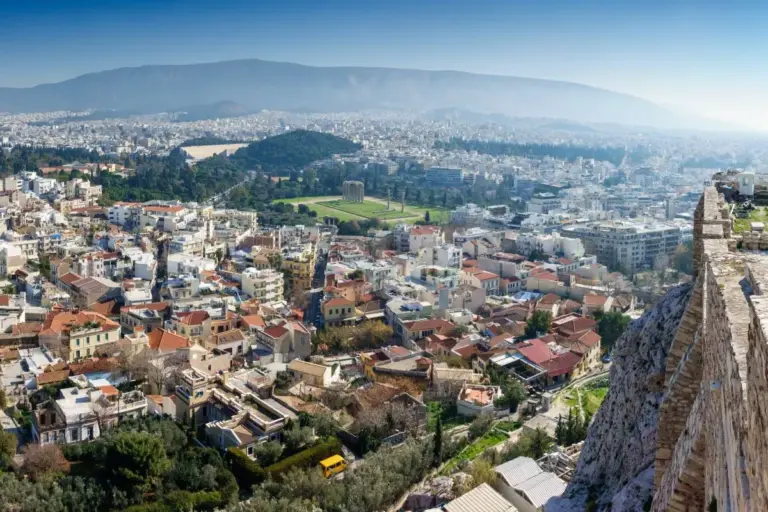
Athens remains the most dynamic and liquid property market in the country. Its role as the country’s economic centre, international connectivity and diverse neighbourhoods offering different lifestyles and price points draw in buyers.
Popular areas for residential use and investment include Koukaki, Pangrati, Kypseli, and parts of the Athens Riviera, depending on proximity to services, transport links, and the city centre.
Property prices are generally higher than in other Greek cities, particularly in central or coastal locations. However, Athens also offers solid long-term fundamentals and sustained demand for short-term rentals in certain areas, subject to local regulations and market conditions.
For a neighbourhood-by-neighbourhood breakdown including Golden Visa thresholds and legal specifics, see our guide to buying property in Athens.
Thessaloniki: a growing urban market with strong long-term fundamentals
Greece’s second-largest city, Thessaloniki is a major academic, cultural, and commercial hub. It attracts buyers looking for a lively urban environment with a strong local economy, as well as a more accessible property market compared to Athens.
Large universities, a growing technology and services sector, and an international airport support consistent demand for housing. Neighbourhoods near the city centre and along the waterfront are often seen as having growth potential while offering more moderate prices than comparable areas in the capital.
Thessaloniki offers a combination of year-round activity and a strong cultural identity, making it suitable for both long-term residence and investment in the local rental market.
Patras: an affordable city with strong local demand and connectivity
Patras offers one of the most affordable urban property markets in Greece, appealing to buyers seeking lower entry prices while retaining access to city-level infrastructure. It is an important port city with a sizeable local population and a less tourism-driven economy.
Its port provides regular maritime connections to other European destinations, particularly across the Adriatic, which is relevant for buyers who value sea-based transport links. Compared to larger cities, Patras has a more relaxed pace of life, while still offering universities, hospitals and essential services.
This combination makes Patras an attractive option for buyers who prioritise affordability, stability and everyday functionality over high-profile investment markets.
Volos and Larissa: balanced regional cities with competitive property markets
Volos and Larissa represent medium-sized urban centres that combine everyday functionality with a relatively high quality of life. Both cities serve as regional hubs, offering hospitals, universities and administrative services, but without the scale or congestion of larger metropolitan areas.
Property prices in these markets remain comparatively competitive, particularly when measured against those in Athens or major island cities. Volos benefits from its coastal location and proximity to Mount Pelion, while Larissa has a strong local economy based on agriculture, education, and services. Together, they appeal to buyers seeking long-term residence, stability and access to urban amenities and natural surroundings.
Heraklion (Crete): an urban property market with island advantages
Heraklion occupies a unique position in the Greek property landscape. As the capital of Crete, it combines the infrastructure and services of a major city with the dynamics of an island economy, attracting both local residents and international property investors.
The city offers a wide variety of properties, ranging from apartments in central neighbourhoods to residential developments on the outskirts. Demand is supported by a permanent local population, universities, hospitals and year-round commercial activity. At the same time, Heraklion benefits from strong international connectivity through its airport, which offers regular flights to major European hubs, making the city accessible for owners and visitors alike.
For buyers seeking city-level amenities without leaving an island setting, Heraklion is a practical and balanced choice.
Comparing the main Greek cities for property buyers
Choosing the right city in Greece depends on how different urban markets perform in terms of pricing, demand, infrastructure, and lifestyle. While all cities offer year-round services and legal clarity compared to villages or islands, their property markets differ significantly in scale, maturity, and cost.
The table below provides a comparative overview of the main cities discussed in this guide. The price figures are indicative averages per square metre and should be understood as broad ranges, as values can vary considerably depending on the neighbourhood, property type and condition.
| City | Market profile | Typical buyer profile | Connectivity | Indicative average price per m² |
|---|---|---|---|---|
| Athens | Large, liquid, international | Investors, expats, long-term residents | International airport, metro, highways | €2,200–€4,000+ |
| Thessaloniki | Growing, urban, student-driven | Residents, buy-to-let investors | International airport, rail, port | €1,600–€3,000 |
| Patras | Affordable, locally driven | Budget-conscious buyers | Port, road links | €1,200–€2,000 |
| Volos | Medium-sized, residential | Lifestyle buyers | Road, regional access | €1,300–€2,200 |
| Larissa | Regional, stable | Local and long-term residents | Rail, highways | €1,200–€2,000 |
| Heraklion | Urban-island hybrid | Residents, mixed-use buyers | International airport, port | €1,800–€3,200 |
Indicative prices are based on broad market averages and should not be used as a substitute for a property-specific valuation.
This comparison shows that there is no single ‘best’ city in absolute terms. Athens and Thessaloniki offer size and market activity, while regional cities offer affordability and practicality. Island capitals such as Heraklion strike a balance between the two, combining urban services with tourism-driven demand.
Practical considerations when choosing the right Greek city
Rather than focusing on headline prices or general reputation, selecting the right city should start with a clear definition of priorities. Budget is important, but it should be considered alongside the type of property you are looking for, whether that’s a modern apartment, a long-term residence or a rental-oriented asset.
Accessibility is another key factor. Cities with international airports or strong transport links offer greater flexibility, particularly for foreign buyers who plan to travel frequently or manage a property from abroad. Rail and road connections also matter for everyday mobility and long-term convenience.
Lifestyle expectations should also be considered. Larger cities provide a more dynamic environment, cultural life and employment opportunities, whereas medium-sized cities tend to offer a quieter lifestyle and lower living costs. Buyers open to less prominent urban markets will find that several lesser-known Greek cities offer exactly this combination, with stable local populations and competitive entry prices. Understanding how these differences align with personal or investment goals can help to narrow down choices effectively.
Finally, buyers should consider long-term factors such as local demand, resale potential and the availability of services, including healthcare and education. Taking a structured approach to the decision-making process makes it easier to identify a city that will remain suitable well beyond the initial purchase.
Choosing the right city to buy a home in Greece
Greek cities offer a wide range of property opportunities, from large, liquid markets such as Athens and Thessaloniki, to more affordable regional centres and island capitals, which have strong local demand. The comparison across these six cities points to one consistent pattern: the right market is the one that matches how you intend to use the property. Athens and Thessaloniki reward buyers who want liquidity, rental demand, and urban infrastructure. Regional cities reward buyers who want lower entry costs and a permanent community without the scale of a capital. Heraklion sits between the two, combining city-level services with island dynamics. Each city has a different combination of prices, lifestyles, accessibility and long-term stability, so it is important to look beyond general trends and reputations.
There is no universally “best” city in which to buy a home in Greece. The right choice depends on individual priorities, including budget, intended use of the property and expectations regarding everyday living or investment performance. Carefully evaluating these factors, together with the legal and practical characteristics of each market, is key to making a sustainable decision.
Before committing to a location, it is worth testing your assumptions on the ground. A city that reads well on paper can feel different when you factor in the specific neighbourhood, the condition of available stock, and the legal profile of a particular property. If you are weighing up more than one city, or if you have identified a property and want to understand the legal considerations for that specific location and purchase type, that is exactly the kind of question an In-Depth Property Consultation is designed to answer.